
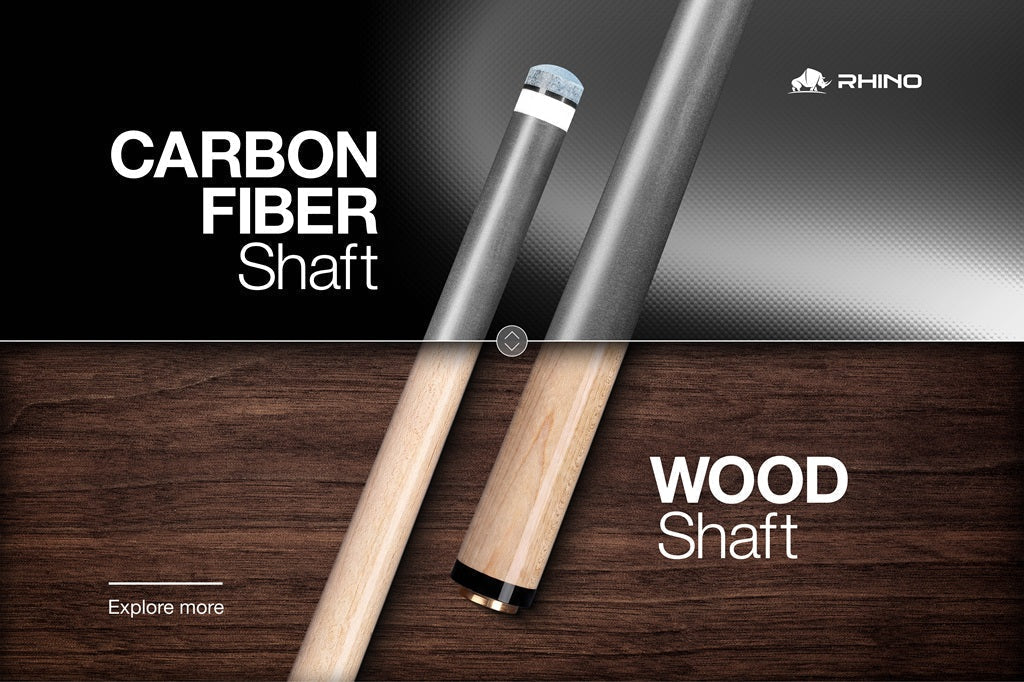
Hard maple wood has long been the traditional choice for pool shafts. In recent years, however, carbon fiber shafts have gained growing popularity among both casual and competitive players.
Why are more players making the switch? The core idea is simple: a shaft should deliver predictable results every time so you can focus on your game. Below, we compare carbon fiber and wood shafts side by side to help you decide if an upgrade makes sense for you.
The Quick Breakdown: Carbon Fiber vs. Wood
Before diving into the technical details, here is a quick side-by-side comparison of how these two materials perform on the table:
|
Feature / Performance Metric |
Traditional Wood Shafts |
Carbon Fiber Shafts |
|
Durability & Straightness |
Prone to warping over time due to weather and moisture |
High Structural Stability: greater resistance to warping and environmental changes |
|
Deflection (Cue Ball Squirt) |
Higher deflection (requires manual aim compensation) |
Low Deflection: minimal deflection for higher accuracy |
|
Maintenance |
Requires more care to protect from moisture, dirt, and environmental changes |
Ultra-low maintenance; cleans easily with a simple wipe |
|
Consistency & Power |
Natural variations in wood can affect consistency |
Uniform structural density |
Key Advantages of Carbon Fiber Shafts
1. Exceptional Straightness & Long-Term Stability: Zero Warping, Total Durability
One of the main challenges of a traditional wooden shaft is its sensitivity to environmental changes. Changes in humidity, temperature, and storage conditions can affect natural wood over time, potentially contributing to warping and changes in straightness.
Carbon fiber shafts significantly reduce this concern. Carbon fiber is impervious to humidity and temperature shifts - meaning it stays laser-straight regardless of weather, time, or storage conditions. This makes a carbon fiber pool cue shaft particularly well suited to players who travel frequently, play in changing conditions, or simply want a shaft that can maintain its characteristics more consistently over long-term use. When you invest in a quality carbon shaft, you are getting years of consistent performance without worrying about warping cues.
2. Low Deflection for Superior Control
When you apply side spin (English) to a cue ball, a phenomenon called deflection (or squirt) pushes the cue ball off its intended path. Because wooden shafts carry extra weight near the tip, their heavy front end resists flexing sideways when contacting the ball. This added inertia acts like a wall, shoving the cue ball off its original aiming line. To make up for this higher deflection, players have to manually misaim every spin shot—spending energy calculating equipment errors instead of trusting their stroke.
Carbon fiber shafts are engineered with lightweight front-end construction, drastically reducing cue ball squirt. For instance, Rhino carbon fiber shafts feature a specialized hollow-core design near the tip to shed critical front-end weight, minimizing deflection to the absolute lowest level. Less deflection means less aim correction and more control on every shot. Players can focus purely on the line and speed without compensating for natural deflection.

Low-deflection performance of a Rhino cue
3. Low Maintenance & Easy Cleaning
Compared with traditional wood shafts, carbon fiber pool cue shafts generally require less routine maintenance. Their smooth, non-porous surface is less susceptible to moisture and makes sweat, hand oils, chalk, and other surface residue easier to remove.
Keeping a Rhino carbon fiber shaft clean is simple. A quick wipe with a microfiber cloth or a mild alcohol pad is all it takes to maintain a silky-smooth glide and keep your cue looking brand new.
 Rhino carbon fiber shafts: Only need a dry, clean cloth for daily care
4. Engineered for Consistency & Efficient Energy Transfer
Natural wood naturally varies in grain and density, making every piece slightly different. In contrast, carbon fiber shafts are built with uniform structural density to deliver total consistency every time. As a result, energy transfers cleanly and efficiently from your stroke straight into the cue ball, delivering maximum power with less effort and ensuring identical feedback shot after shot.
Does Wood Still Have a Place on the Table?
Absolutely. While carbon fiber has become increasingly popular in modern cue design, wooden shafts still offer characteristics that many players value:
-
Classic Feedback: some traditionalists prefer the damp, natural vibration and sound of solid maple hitting a cue ball.
-
Budget Considerations: entry-level wood shafts generally carry a lower initial price point for casual players.
However, modern engineering has narrowed the difference in feel between carbon fiber and traditional wood. Rhino Carbon Shafts, for instance, feature specialized foam composite cores designed to absorb unwanted vibrations, create a crisp, solid hit with more natural feedback. This brings some of the familiar responsiveness players appreciate in wood while maintaining the stability, consistency, and low-deflection performance of carbon fiber.
Who Should Upgrade to a Carbon Fiber Shaft?
Upgrading your pool cue equipment is a personal choice, but a carbon shaft is particularly beneficial if you fall into any of these categories:
-
Competitive Players: if you need 100% consistency under pressure, a carbon shaft delivers identical performance shot after shot.
-
Frequent Travelers: if you take your cues on the road, play in varied climates, or store gear in your vehicle, warp resistance is essential.
-
Players Seeking Better Precision: if you want to master position play with side spin without calculating heavy deflection adjustments, low-deflection carbon is a game-changer.
Upgrade Your Game with Modern Shaft Technology
While traditional wood holds nostalgic value, carbon fiber technology offers unmatched accuracy, durability, and performance. Removing equipment variables allows you to focus on what truly matters: perfecting your stroke and winning games.
Ready to experience the ultimate combination of precision and durability? Rhino Carbon Shafts deliver top-tier low deflection, warp-free durability, and exceptional hit feedback at a fraction of the cost.


0 comments